
Why Sewer Backup Coverage Matters for New Jersey Homeowner

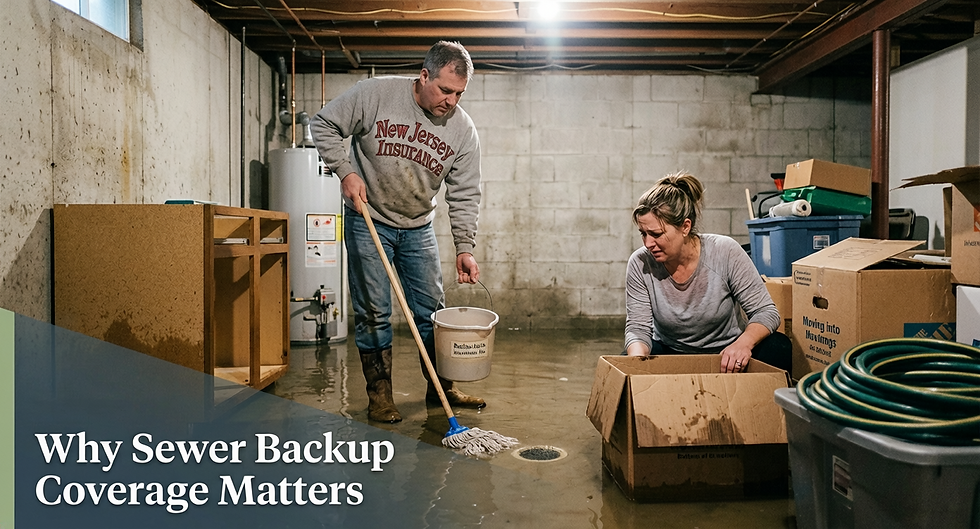
For many New Jersey homeowners, the basement is one of the most valuable—and vulnerable—parts of the house. It may contain a finished family room, laundry area, home office, furnace, water heater, storage, or thousands of dollars’ worth of personal belongings. Unfortunately, one of the messiest and most expensive problems a homeowner can face can begin with something as simple as water moving in the wrong direction through a drain.
A sewer backup can happen during a period of heavy rain, when a municipal sewer system becomes overwhelmed, when a sewer line becomes clogged with roots or debris, or when a private sewer lateral develops a problem. And there is an important insurance detail many homeowners discover only after the damage occurs: a standard homeowners policy generally does not automatically cover water or sewage that backs up through a sewer or drain.
New Jersey's Department of Banking and Insurance specifically identifies sewer backup and sump-pump overflow as coverage that may need to be added by endorsement, noting that it is often subject to a separate, limited amount of coverage.
This is also where a lot of confusion begins. There are actually two different problems that homeowners often call "sewer insurance":
Sewer backup coverage: pays for damage inside the home caused by water or sewage backing up.
Sewer line/service line coverage: helps pay to repair or replace the underground sewer pipe running from the house toward the municipal sewer system.
They sound similar, but they protect against very different expenses.
What Is Sewer Backup Coverage?
Sewer backup coverage is generally an endorsement added to a homeowners insurance policy. Depending on the insurance company, it may be called water backup, sewer and drain backup, water backup and sump pump overflow, or sewer backup coverage.
The purpose is relatively straightforward: if water or sewage backs up through a drain, toilet, sewer connection, or other covered system and damages your property, the endorsement can provide coverage for the resulting damage.
Without the endorsement, that same event may fall under an exclusion in the standard homeowners policy.
For example, imagine a New Jersey homeowner has a finished basement with:
$8,000 worth of flooring
$5,000 worth of furniture
$3,000 worth of electronics
Finished drywall and walls
A bathroom
Stored clothing and personal belongings
After several hours of heavy rain, the municipal sewer system becomes overwhelmed. Wastewater reverses through the home's sewer connection and comes up through the basement floor drain.
The sewage spreads across the basement.
The homeowner may now have expenses for water extraction, sewage cleanup, disinfecting, flooring removal, drywall replacement, furniture replacement, and potentially damaged personal property.
The important question isn't simply "Do I have homeowners insurance?"
It's:
"Do I have the appropriate water/sewer backup coverage, and is the limit high enough?"
What Does Sewer Backup Coverage Typically Pay For?
The exact coverage depends on the insurance company and endorsement, but sewer backup coverage can generally address the damage resulting from the backup, rather than simply the existence of a plumbing problem.
Potential covered expenses may include:
Water and sewage removal.Professional cleanup can be necessary because sewage is a contamination hazard. It isn't simply a matter of using a shop vacuum and drying the floor.
Damaged flooring.Carpet, laminate, hardwood, tile, or other flooring can be damaged or contaminated.
Drywall and finished walls.If contaminated water reaches drywall, portions may need to be removed and replaced.
Damaged personal property.Furniture, clothing, appliances, electronics, boxes of stored belongings, and other personal property can potentially be covered, subject to the policy terms and applicable limits.
Cleanup and sanitization.Professional remediation can be an important part of restoring the property.
Additional living expenses in applicable situations.Depending on the policy and circumstances, additional living expense coverage may apply if a covered loss makes the home uninhabitable.
New Jersey's Department of Banking and Insurance specifically recommends that homeowners ask about sewer backup or sump-pump overflow coverage and notes that the coverage is commonly limited.
One of the Biggest Mistakes: Assuming Your Homeowners Policy Covers Everything
A homeowner might reasonably think:
"I have homeowners insurance. If something floods my basement, insurance will pay."
Unfortunately, insurance doesn't work that broadly.
There is a major distinction between water entering the house from outside and water backing up through a sewer or drain.
There is also a distinction between a covered sudden loss and an excluded maintenance or wear-and-tear problem.
For example:
Scenario 1: Sewer backs up through the basement drain
Heavy rain overwhelms the sewer system, and sewage comes up through the basement drain.
That is the type of event a water/sewer backup endorsement is designed to address, subject to the policy's terms, limits and deductible.
Scenario 2: Rainwater enters through the basement window
A major storm causes water to accumulate around the house. Water enters through a basement window.
That may be considered flood or surface-water damage rather than sewer backup. Standard homeowners insurance generally does not cover flood damage.
New Jersey's insurance department explains that homeowners policies exclude flood damage and directs consumers to the National Flood Insurance Program for flood protection.
Scenario 3: A sewer pipe collapses underground
The homeowner discovers that the buried sewer lateral has collapsed because of age, roots, corrosion, or another problem.
This is a different problem again.
The cost of repairing the underground sewer line is not necessarily the same thing as the cost of repairing damage inside the house caused by sewage backing up.
That distinction is extremely important.
Sewer Backup Coverage vs. Sewer Line Coverage
Think of the sewer system as a pipe running from your house toward the municipal sewer.
If something goes wrong, there are potentially two separate financial problems.
Problem 1: The pipe itself fails
The underground sewer lateral cracks, collapses, becomes blocked by tree roots, or otherwise fails.
Someone has to excavate the property, locate the problem, repair or replace the pipe, and then restore the landscaping, driveway, sidewalk, or other surfaces disturbed during the work.
That's where service line/sewer line protection comes in.
Problem 2: Sewage gets into the house
Because the line is blocked or the public sewer backs up, wastewater enters the basement.
Now you're dealing with contaminated water, damaged flooring, drywall, furniture, personal belongings, and cleanup.
That's where sewer backup coverage comes in.
These coverages can complement one another.
One protects the pipe. The other protects against the resulting indoor damage.
What Is Sewer Line or Service Line Coverage?
Sewer line coverage is designed to address the underground line itself.
In New Jersey, this is particularly relevant because homeowners can be responsible for the private sewer lateral connecting their property to the municipal system.
NJDEP, for example, specifically identifies privately owned sewer laterals as homeowner responsibilities in portions of the state. In its Wreck Pond watershed program, NJDEP states that sewer laterals carrying wastewater from private homes to the municipal sanitary sewer are the responsibility of individual homeowners.
That means the fact that you pay a sewer bill to your municipality does not necessarily mean the municipality is responsible for every foot of pipe associated with your house.
Generally, there is a point where the homeowner's private system connects to the public system, although the exact ownership and maintenance responsibility can vary by municipality and utility.
This is something New Jersey homeowners should verify with their particular town or sewer authority.
The "Town or Water Company" Sewer Protection Plan
Another source of confusion is the sewer protection offer that homeowners sometimes receive through their municipality or water utility.
A homeowner might receive a letter saying something like:
"Protect your sewer line for a few dollars a month."
These programs are often not the same thing as homeowners insurance.
Municipalities and utilities sometimes partner with third-party companies to offer optional service-line protection programs. HomeServe, for example, operates programs through municipalities and utilities that can cover private-side exterior water and sewer lines.
The important thing is to read the actual contract.
A service-line plan might cover things such as:
Locating a failed line
Excavation
Repairing a sewer line
Replacing portions of the line
Root intrusion
Certain blockages
Backfilling
Restoration of disturbed landscaping
The exact coverage varies significantly between programs.
For example, one HomeServe program describes exterior sewer coverage from the external wall of the home to the point where the utility becomes responsible and provides coverage for certain blocked or leaking lines.
That's very different from an insurance endorsement that pays for damage to your finished basement.
A Realistic New Jersey Example
Imagine a 70-year-old home in Bergen County.
The house has mature trees in the front yard, and the sewer lateral connecting the house to the street is decades old.
One Saturday morning, the homeowner notices that several toilets aren't draining properly. Then water begins coming up through the basement floor drain.
A plumber performs a camera inspection and discovers tree roots have entered the underground sewer lateral.
The homeowner now has two problems.
First, the sewer lateral needs to be cleared or repaired.
Second, several inches of contaminated water have entered the basement.
Suppose the following expenses occur:
Sewer line excavation and repair: $7,500
Emergency sewage cleanup: $2,000
Damaged flooring: $5,000
Drywall repairs: $3,000
Damaged furniture and personal property: $4,000
That's potentially a $21,500 problem.
A sewer-line protection plan could potentially address the underground pipe repair, depending on its terms.
A sewer-backup endorsement could potentially address the resulting indoor damage, subject to its coverage limit and deductible.
Neither coverage necessarily replaces the other.
Another Example: The Town Sewer Is the Problem
Now consider a completely different situation.
A major rainstorm hits a New Jersey community. The municipal sewer system becomes overwhelmed.
The homeowner's private sewer line is perfectly fine.
But wastewater from the public system backs up through the home's sewer connection and comes out through the basement drain.
There may be nothing wrong with the homeowner's private sewer pipe.
The problem is the backup.
This is exactly why sewer backup coverage can be valuable even when a homeowner has no reason to believe their own sewer lateral is damaged.
The homeowner may never need sewer-line repair coverage for this particular claim, but could still have thousands of dollars of interior damage.
How Much Does Sewer Backup Coverage Cost?
The price varies by insurance company, property, location, coverage limit, deductible and other underwriting factors.
As a general industry range, sewer backup endorsements are often relatively inexpensive compared with the potential cost of a serious loss. Current consumer insurance sources commonly cite roughly $50 to $250 per year, depending heavily on the limit and policy.
New Jersey's Department of Banking and Insurance notes that sewer backup/sump-pump overflow coverage is commonly limited to around $5,000 on policies where that endorsement is offered at that level.
The important point is not simply whether the endorsement costs $50, $100 or $200 a year.
The bigger question is:
How much coverage are you actually buying?
A $5,000 limit may sound substantial until you have a finished basement with $20,000 or $30,000 of improvements and belongings.
A homeowner should ask the insurance agent:
"What is my sewer backup limit, and can I increase it?"
How Much Does Sewer Line Protection Cost?
Service-line protection plans are priced differently because they are designed to pay for repairs to the underground line rather than damage to the home.
Prices vary by provider and location. Some plans are offered for only a few dollars per month, while broader packages cost more.
For example, HomeServe currently advertises plans in some markets starting at several dollars per month, with exterior sewer/septic-line plans in some markets costing around $10 per month. Availability, pricing and terms vary by location.
Another provider, American Water Resources, describes sewer-line protection with per-occurrence limits and separate provisions for things such as excavation and restoration.
These numbers shouldn't be treated as a universal New Jersey price. A homeowner needs to look at the actual plan available for their municipality.
Be Careful: A Protection Plan Is Not Automatically "Insurance"
This is one of the most important distinctions for homeowners.
A sewer-line protection plan offered through a municipality or utility may be a service contract or protection plan, rather than an endorsement on your homeowners insurance policy.
That can mean different rules regarding:
Waiting periods
Pre-existing conditions
Contractor selection
Service-call procedures
Coverage limits
Eligible pipe sections
Root intrusion
Excavation
Landscaping restoration
Road or sidewalk restoration
Annual limits
Cancellation
Deductibles or service fees
For example, some service programs require the homeowner to contact the program before hiring a contractor.
That means a homeowner shouldn't simply assume:
"I pay for the sewer protection plan, so I can call any plumber and get reimbursed."
The contract may require you to use the program's approved process.
Why New Jersey Homeowners Should Pay Particular Attention
New Jersey has a large number of older homes and mature neighborhoods, meaning underground infrastructure can be decades old. Aging sewer laterals can develop cracks, root intrusion, corrosion and other problems.
At the same time, New Jersey communities experience significant rainfall and major storms, creating situations where sewer systems can become stressed.
NJDEP has specifically documented concerns involving broken private sewer laterals and homeowner responsibility in parts of the state.
This doesn't mean every New Jersey homeowner is destined to experience a sewer backup.
It does mean homeowners should understand who is responsible for their sewer line before something goes wrong.
What Should a New Jersey Homeowner Ask?
A good conversation with an insurance agent, municipality, sewer authority or utility should answer several basic questions:
Does my homeowners policy include sewer backup coverage?
If not, can I add it?
What is my sewer backup limit?
Does the coverage include personal property?
Does it cover sump-pump overflow?
What deductible applies?
Does the endorsement cover the sewer pipe itself, or only damage caused by the backup?
Where does my responsibility for the sewer lateral end?
Does my municipality offer a private sewer-line protection program?
Does my water/sewer company offer one?
Who administers the program?
What does the service plan actually cover?
Are tree roots covered?
Does it cover excavation and restoration?
Are there waiting periods or pre-existing-condition exclusions?
These questions can prevent an unpleasant surprise when the basement is already full of wastewater.
The Bottom Line: You May Need Both
Sewer backup coverage and sewer-line protection are often confused because they sound like the same thing.
They aren't.
Sewer backup coverage primarily addresses the damage caused when wastewater backs up into the home.
Sewer-line/service-line protection primarily addresses the underground pipe itself.
And then there is a third category: flood insurance, which addresses qualifying flood losses and is not simply a substitute for sewer backup coverage. New Jersey's Department of Banking and Insurance specifically distinguishes flood coverage from sewer backup protection.
A homeowner could therefore have a situation where:
The municipal sewer backs up → sewer backup coverage may respond.
The private sewer lateral collapses → service-line coverage may respond.
Sewage enters the basement because the lateral collapses → sewer backup coverage may address resulting interior damage, while service-line coverage may address the pipe, depending on the respective contracts.
Rainwater enters through a basement door → flood coverage may be the relevant coverage, if the loss meets the flood policy's definition and terms.
The key is understanding that "sewer insurance" isn't one universal coverage.
For New Jersey homeowners, a few dollars spent understanding the difference between sewer backup coverage, sewer-line protection and flood insurance can make a significant difference when something goes wrong. A homeowner may already have one of these protections without realizing what it actually covers—or may have none of them.
Before the next major storm or plumbing emergency, it's worth pulling out the homeowners policy, looking at the endorsements, checking the coverage limits, and determining exactly where the homeowner's responsibility for the private sewer lateral begins and ends.
A sewer problem can be unpleasant enough. Finding out after the fact that you had the wrong coverage can make it considerably more expensive.
Coverage terms, exclusions, limits, deductibles and premiums vary by insurance company and service-plan provider. The examples above are illustrative rather than guarantees of coverage. New Jersey homeowners should review their individual policy and the specific service agreement available through their municipality or utility.



Comments