
Is Your Homeowners Insurance Stuck in the 90s?: Why Your iPhone and Engagement Ring Need Better Protection
- joseph retcho
- May 8
- 5 min read

It wasn’t that long ago that the most valuable thing in a teenager's bedroom was a collection of baseball cards; today, between high-end smartphones, pro-level gaming laptops, and designer accessories, the average household "tech and trek" value has skyrocketed.
People often ask me, "Am I covered if my phone gets swiped at the coffee shop?" or "What happens if my grandmother's engagement ring disappears?" The answer, as with most things in insurance, is: It depends on how you’ve set up your safety net.
We are going to unpack the world of Scheduled Items, Blanket Coverage, and the often-misunderstood Standard Homeowners Limits. Whether you're a collector of fine art or just someone with a very expensive MacBook, understanding these nuances is the difference between a check that covers your loss and a very expensive lesson in fine print.
The Cold, Hard Truth: Crime and Theft Statistics in 2026
Before we talk about coverage, let's talk about why we need it. The world is changing, and so is the way property crime happens.
The Rise of "Small-Target" Theft
According to recent data, property crimes in the U.S. maintained a general downward trend for nearly two decades, but we’ve seen specific upticks in high-value, portable items (Kelsay et al., 2024). While traditional "home burglaries" are evolving, "theft from motor vehicles" and "theft in public spaces" have become serious challenges. In fact, motor vehicle thefts rose nearly 11% between 2021 and 2022, a trend that continued into 2023 with a staggering 33.5% increase across major U.S. cities (Kelsay et al., 2024).
Why does this matter for your home insurance? Because most people don’t realize that homeowners insurance follows you. If your laptop is stolen from your car or your jewelry is swiped from a hotel room, it’s usually your home or renters policy that responds—not your auto insurance.
Commodity-Driven Crime
Criminals are savvy investors. Recent research highlights a direct link between the rising prices of precious metals and the frequency of specific thefts (IZA Institute of Labor Economics, 2024). When the market price for gold, silver, or even the metals in catalytic converters spikes, we see a corresponding rise in the theft of those materials (IZA Institute of Labor Economics, 2024). This makes your silverware set and your jewelry box higher-priority targets than they were five years ago.
Level 1: Standard Homeowners Coverage (The "Base Layer")
Every standard homeowners policy (typically called an HO-3) includes "Coverage C," which is your Personal Property coverage. Usually, this is set at 50% to 70% of your home’s dwelling limit. If your house is insured for $400,000, you likely have $200,000 in contents coverage.
The Catch: This sounds like plenty, but standard policies have Sub-Limits for specific categories of items. These sub-limits apply specifically to the peril of theft.
Common Theft Sub-Limits:
Jewelry/Watches/Furs: Often limited to $1,500 total.
Silverware/Goldware: Often limited to $2,500 total.
Firearms: Often limited to $2,500 total.
Business Property: Often limited to $2,500 on-premises and much less off-premises.
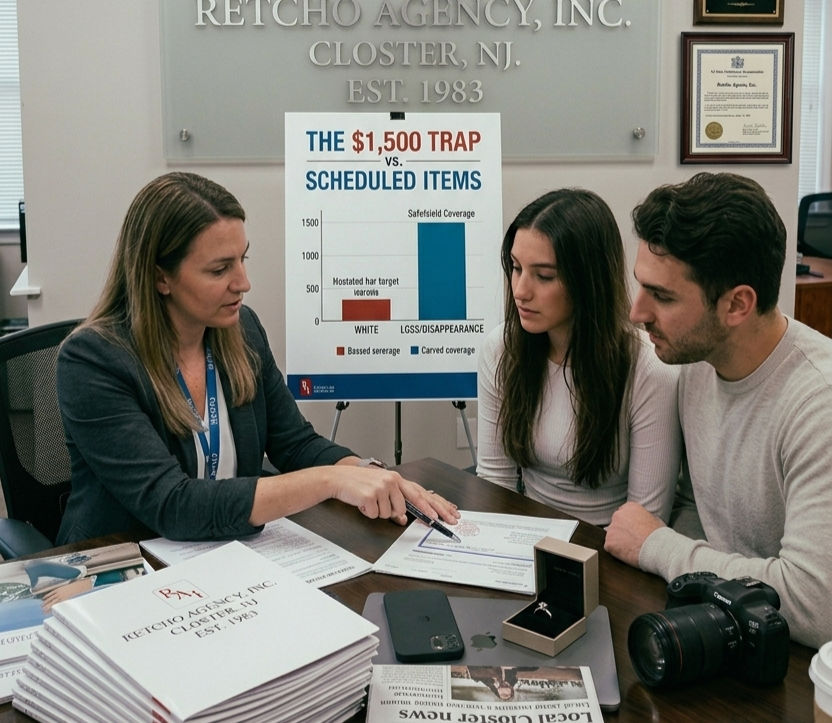
If you have a $10,000 engagement ring and it is stolen, a standard policy will only pay you $1,500. You are out $8,500. This is where the "standard" policy fails the modern consumer.
Level 2: Blanket Coverage (The "Middle Ground")
If you have more than the average amount of jewelry or electronics but don't want to list every single item, you might look at Blanket Coverage (also known as a "Personal Property Blanket").
How it Works:
Instead of a $1,500 limit for all jewelry, you might "blanket" your jewelry for $10,000. This increases the total amount available for a loss.
Pros: It’s easier. You don't have to provide appraisals for every single pair of earrings.
Cons: There is still a per-item limit. For example, a $10,000 blanket might still limit any single item to $2,500. If that $10,000 ring is stolen, you're still coming up short.
Level 3: Scheduled Personal Property (The "Gold Standard")
This is the "Scheduled Items" coverage the pros use. "Scheduling" an item means you are listing it specifically on your policy with its own individual value and description.
What can you schedule?
Jewelry: Engagement rings, high-end watches (Rolex, Patek Philippe), heirloom necklaces.
Fine Art: Paintings, sculptures, and rare prints.
Silverware: Full sets of sterling silver.
Musical Instruments: That $5,000 Gibson or a professional-grade cello.
Electronics: High-end gaming rigs, pro-video cameras, or high-priced smartphones.
Sports Equipment: High-value bicycles or golf clubs.
Why Scheduling is Superior:
Agreed Value: You and the insurance company agree that the item is worth $X. If it’s lost, that’s what you get.
Mysterious Disappearance: This is huge. Standard policies cover theft. Scheduled coverage covers loss. If your diamond falls out of the setting at the beach, a standard policy says "Sorry." A scheduled policy says "Here is your check."
No Deductible: In most cases, scheduled items have a $0 deductible. If your $2,000 MacBook is stolen, you get the full $2,000, rather than $2,000 minus your $1,000 home deductible.
Worldwide Coverage: Your items are protected whether they are in your dresser, in your car, or in a suitcase in Paris.
Requirements: How to Get Scheduled Coverage
Insurance companies don't just take your word for it that your watch is worth $20,000. Because these policies offer such broad protection, the "underwriting" (the vetting process) is stricter.
1. The Appraisal
For items like jewelry and art, you must provide a professional appraisal, usually dated within the last 2-3 years. This appraisal must include:
A detailed description (cut, color, clarity, and carat weight for diamonds).
The metal type (14k gold, platinum, etc.).
The "Replacement Value" in the current market.
2. Proof of Purchase
For electronics or newer items (like that $1,500 iPhone 17 Pro Max), a detailed receipt is often sufficient. It must show the date of purchase, the model/serial number, and the price paid.
3. Detailed Photos
Most adjusters now require clear, high-resolution photos of the item, including any serial numbers or hallmarks (the tiny stamps on the inside of a ring).
Electronics: The New Frontier of Insurance
Ten years ago, we didn't schedule cellphones. Today, with phones hitting the $1,500–$2,000 mark and laptops reaching $4,000, they have become "high-risk" portables.
The Reality Check: While you can schedule a cellphone, I often advise clients to look at the math. A phone loses value (depreciates) incredibly fast. Unlike a diamond, which stays relatively stable in price, a three-year-old iPhone is worth a fraction of its original cost.
However, for professional equipment—if you are a photographer, a graphic designer, or a coder—scheduling your gear is non-negotiable. If a coffee spill fries your $5,000 workstation, a standard policy might consider that "user error" or apply a high deductible. A scheduled "computer floater" can protect against accidental damage and spills.
Summary Comparison Table
Feature | Standard Homeowners | Blanket Coverage | Scheduled Coverage |
Typical Theft Limit | $1,500 (Jewelry) | $5,000 - $10,000 | Full Appraised Value |
Deductible | Subject to Home Deductible | Subject to Home Deductible | Usually $0 |
Mysterious Disappearance | Not Covered | Usually Not Covered | Covered |
Worldwide Protection | Limited | Yes | Yes (Broadest) |
Proof Required | Receipts after loss | General list | Appraisal upfront |
Final Thoughts
If you take away one thing from this guide, let it be this: Don't wait for a claim to find out you're underinsured.
I’ve sat across the desk from too many people who thought their "everything" was covered, only to find out that their $5,000 silver collection was capped at $2,500 by a policy written in 1998.
Take thirty minutes this weekend. Walk through your house with your phone. Take a video of your drawers, your tech, and your jewelry. If you see something that would cost you more than $1,500 to replace, call your agent. Ask about "scheduling" that item. It usually costs about $1–$2 for every $100 of value—a small price to pay for the peace of mind that your "pocket-sized fortune" is actually protected.


Comments